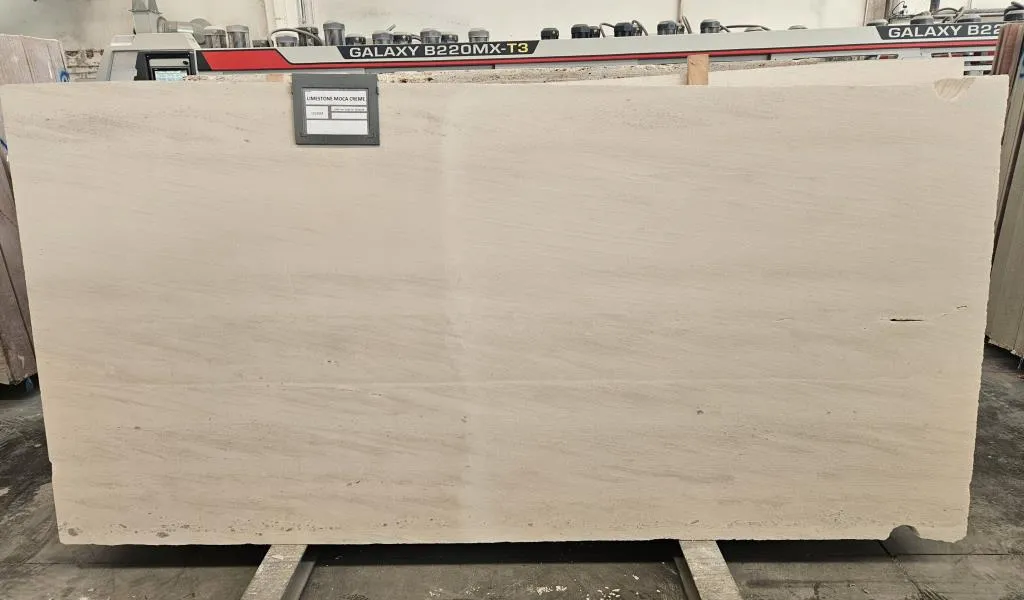
Germany · Limestone
also known as Jura Stone, Jura Limestone, German Limestone
A fine-grained Jurassic limestone from the Franconian Jura plateau in Bavaria, quarried in the Solnhofen area. Warm cream with subtle fossil patterns; popular for contemporary interior and exterior use, well-suited to minimalist architecture.
Type-level physical facts shown. Per-lot lab values (absorption, flexural strength) confirmed at quotation.
Jura limestone is quarried in the Altmühl valley of Bavaria, a landscape of river bends and limestone cliffs that gives a stone of remarkable consistency and quiet sophistication. Its warm grey-beige ground has made it a benchmark for European institutional and hospitality interiors for decades.
Geology. Jurassic marine limestone, ~150 million years old, from the Franconian Alb plateau. Extremely homogeneous fine-to-medium grain with minimal fossil macro-content; occasional ammonites and bivalves visible in certain lots. The even, compact structure accounts for its dimensional stability and workability.
We verify each source against five transparent trust signals and route every enquiry through our desk — you deal with us, not a cold inbox.
Its geological age (Jurassic, ~150 Ma), extreme homogeneity and dimensional stability. It cuts cleanly, holds edges under CNC work, and delivers a very consistent, architecturally calm surface — qualities that explain its dominance in European museum and airport interiors.
Yes. Frost-tested Jura limestone has been used in exterior facades and paving across Central Europe. Specify lots tested to EN 1936 (water absorption) and EN 12371 (frost resistance) for cold-climate exteriors.
Sometimes — occasional ammonites and bivalves appear in certain lots, which some architects specify deliberately as a feature. Standard commercial production is highly uniform; ask for a fossil sample set if you want visible paleontology.