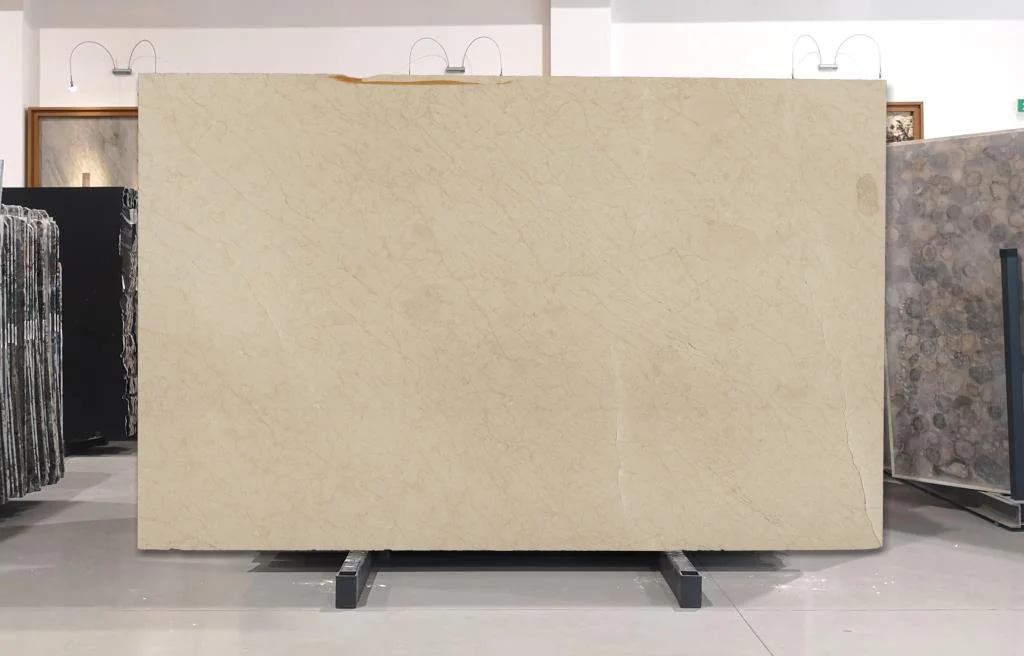
Germany · Limestone
also known as Solnhofer Plattenkalk, Lithographic Limestone, Bavarian Limestone
One of the most extraordinary limestones in the world: a Late Jurassic deposit from Bavaria so fine-grained it was used to invent lithographic printing. Every layer splits naturally into perfectly smooth thin slabs, revealing a pale cream surface of exceptional uniformity, occasionally marked by ghost-like fossil impressions (including the famous Archaeopteryx specimens). Used today for luxury floor tiles, facade cladding, and precision-cut architectural elements requiring a refined, neutral European aesthetic.
Type-level physical facts shown. Per-lot lab values (absorption, flexural strength) confirmed at quotation.
It was deposited in a very quiet, hypersaline lagoon environment during the Late Jurassic, far from wave action or river sediment, allowing calcite particles of only a few microns to settle. This makes it the finest-grained natural limestone commercially quarried anywhere in Europe.
Yes. The Archaeopteryx fossil, the famous transitional species between dinosaurs and birds, was found in Solnhofen limestone quarries in the 19th century. Occasional fossils still appear in commercial stone extraction and are extremely valuable scientifically.